

Sweaty, Stuffy and Loud: Inside the Amazon Warehouse Where Jim Wetmore Died
After the 46-year-old worker collapsed in April, employees and his family began to wonder if working conditions played any part.

The Western Edge is an independent publication supported entirely by our subscribers. The type of investigative journalism we do is tough, fair and gets results — but it also takes financial support to continue. If you believe in the kind of shoe-leather journalism we do, please consider helping us keep this type of work alive in the Pacific Northwest by becoming a paid subscriber. Thank you!
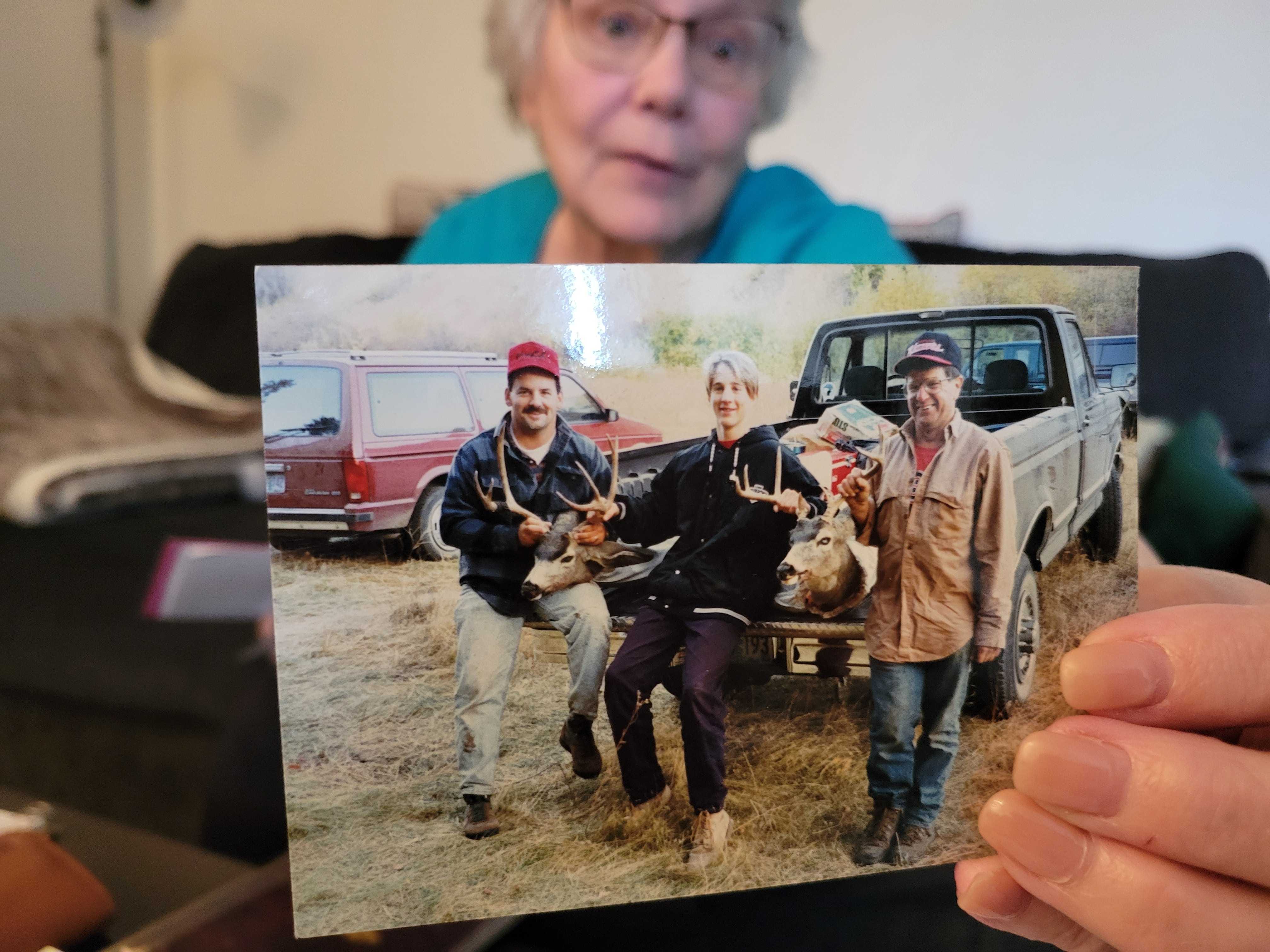
Pam Wetmore held the phone to her ear, racking her brain for anything that might explain what happened to her son.
The Amazon employee on the other end of the line was vague. Jim Wetmore, 46, had a “medical incident” while working inside a sprawling warehouse east of Portland. Could Pam think of anything that might have caused it?
“And I thought, ‘OK, having high blood pressure, that’s a pre-existing condition,’” she remembered. “But he was taking medication for it. Keeping it under control.”
Her son hadn’t complained recently about feeling unhealthy outside some back pain, Pam said. The person on the phone thanked her and said they’d call back when they knew which hospital he was being taken to.
It was around 2 p.m. on April 6. By the time she traveled the three miles from her apartment in Troutdale, Oregon, to the Amazon Fulfillment Center known as PDX9, Wetmore was near death.
Surveillance video showed the tall, thin man pushing a stack of yellow plastic totes along the building’s second floor around 1:40 p.m., slowing as he took each step. Wetmore then leaned over the stack before collapsing and hitting his shaved head on the hard floor. Other Amazon employees, who discovered him unconscious around nine minutes later, began administering chest compressions and applied a defibrillator at the instruction of a 911 dispatcher. Paramedics on scene declared him dead at 2:32 p.m.
Inside the building’s lobby, Pam assumed her son was still alive.
She sat there after an employee told her they’d find a supervisor to speak with her; no one returned. Pam sat there as waves of Amazon staff passed by her, exiting the building around 3:45 p.m., having been told during their last break of the day to stop all work and go home. She sat there as two volunteers from a local trauma response nonprofit entered the lobby; later, they would comfort her.1
Pam only stood up and left that lobby when a detective asked to speak to her privately. There, outside the Amazon warehouse on an unusually warm2 April day, the detective said her son was dead.
“At that point, I wasn’t going to leave until they brought him out,” Pam said, tearfully recalling those moments during a late April interview with The Western Edge.
For the Wetmore family, the lack of clarity around the “medical incident” that led to Jim Wetmore’s death has left them feeling frustrated and angry.
“Someone should have come out to inform my mom what was going on,” said Jennifer Wetmore, his older sister. “They’re just ignoring the woman whose son is dying on the floor.”
Amazon has denied that working conditions inside PDX9 played any role in Wetmore’s death, citing safety inspector reports. The company has called his loss a tragedy, offering sympathies and grief resources to the Wetmores and his co-workers.
But for many frontline staff at PDX9 and Wetmore’s family, skepticism remains over Amazon’s explanation. In the past four years, at least two PDX9 workers have died and a third sustained life altering injuries.
As of this publication, medical examiners are waiting for toxicology results before finalizing Wetmore’s death certificate, according to his family. In a statement, Amazon said its conclusions came after “our site safety team was verbally informed by the Oregon OSHA Compliance Officer that, based on their initial findings, they determined this to be a non-work related medical issue, which aligns with the findings of our own internal investigation.”
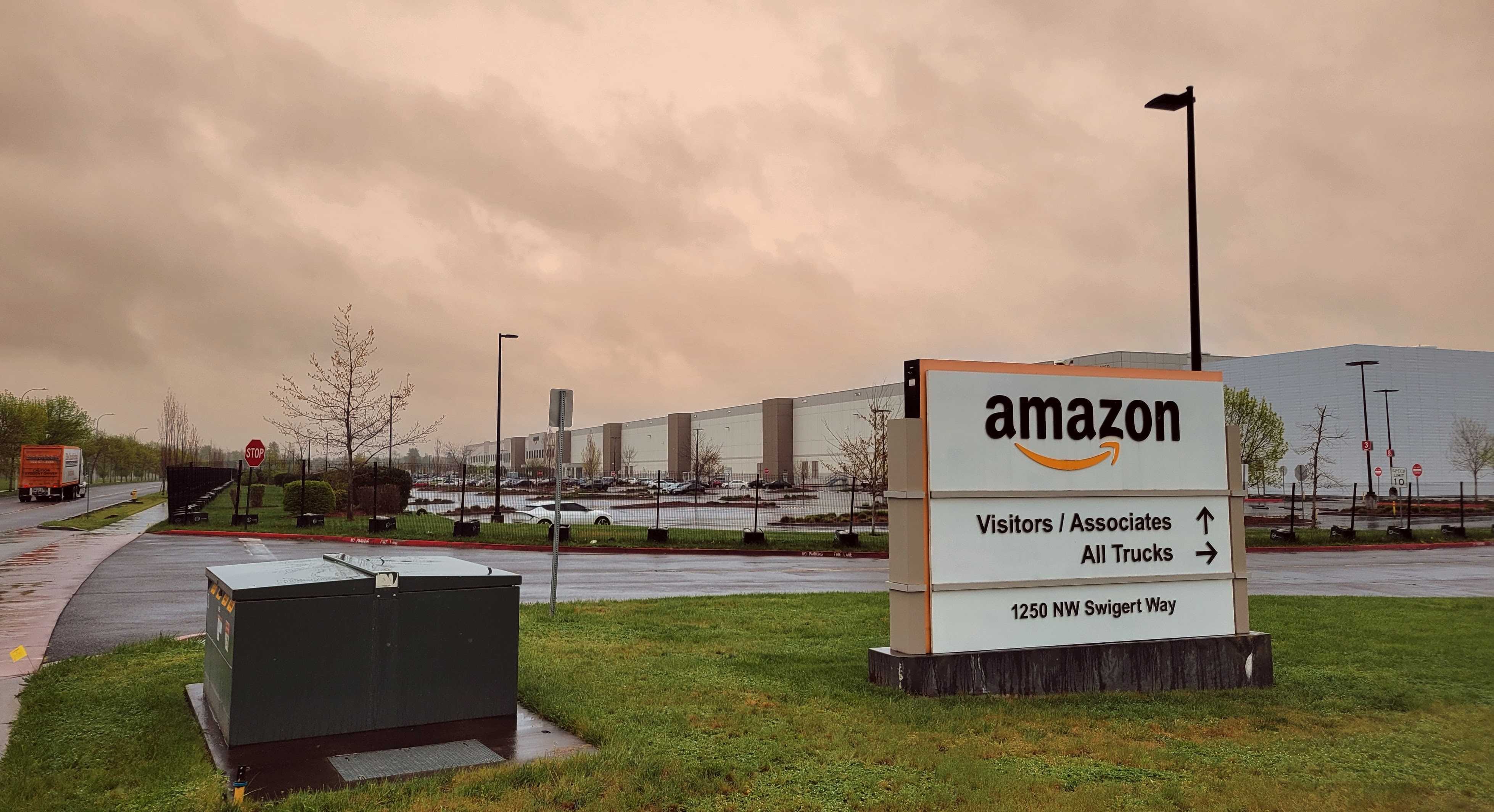
PDX9 workers have described their jobs as physically demanding and question the company’s conclusions that the warehouse environment did not contribute to Wetmore’s death.
Over the past month, The Western Edge has conducted extensive interviews, analyzed hundreds of pages of public safety records, worker’s compensation cases, injury logs and some of Amazon’s own data to detail the working conditions inside PDX9 and to understand why the Wetmores and many employees continue to ask one question: What actually happened to Jim Wetmore?
PDX9 is a 2.3 million-square-foot warehouse, employing more than 3,000 workers over the course of a year. With a workforce of that size, it’s little surprise that emergency services are sometimes needed at the building.
Medical personnel and police are called to PDX9 around 100 times each year, according to emergency dispatch records from April 2024 through April 2026. In many cases, the calls have been for relatively minor incidents: a car theft, a broken-down vehicle, stomach illnesses, allergic reactions.
But around a third of the time, the calls have involved more serious concerns: a young woman with blood pouring out of her mouth after falling and hitting her head, a 27-year-old with chest pains, a person found passed out on the warehouse floor and barely breathing.
The months leading up to Jim Wetmore’s death in early April held no shortage of scares for staff at PDX9. On Jan. 2, 2026, a 59-year-old woman with a history of heart attacks complained of chest pains. She had already taken two doses of nitroglycerin and some baby aspirin, but her pain only worsened, leading her to sweat as she waited for paramedics.
In March, several more employees worried about their hearts. On March 2, a 25-year-old Amazon associate’s skin turned red as he waited for care for chest pains. Five days later, a 20-year-old taking prescribed hormones worried they were having a reaction when their chest began to hurt. On March 23, a 40-year-old man felt pain in the right side of his chest.
“Many of us inside the building are grieving — but also scared.” — Amazon employee
Despite all of those emergency dispatches in the weeks before April 6, some employees have described leaders at PDX9 as unprepared when responding to Jim Wetmore’s collapse, as previously reported by The Western Edge. As Wetmore lay on the floor and staff tried to save him, workers in parts of the building continued to pack orders.3
Amazon said it maintains a ratio of one “first aider” for every 50 employees, and responded appropriately to Wetmore’s collapse.
For many associates, Wetmore’s death simply affirmed their perception that the second-largest private employer in the United States4 views them as replaceable.
“Many of us inside the building are grieving — but also scared. What people don’t see is what conditions are really like day to day. Inside the building, temperatures can get extremely hot,” one employee wrote in a message to The Western Edge. “Associates are often placed in roles or paths that push physical limits and increase risk of injury, especially during night shifts where fewer people are expected to handle more responsibilities.”
Heat is a known problem inside PDX9.
“It’s 49° and raining outside, why is it so damn hot in the building. Turn off the heat,” one PDX9 employee wrote in April on My Voice, an internal message board for Amazon workers.
“I have confirmed there is no heat turned on in the building,” replied Sarah Fink, a senior operations manager at PDX9 and former Marine Corps officer. “Please refrain from using profanity.”
Two employees who spoke to The Western Edge said they frequently wear shorts and T-shirts to work in winter months to stay cool as they pick and pack items. During summer shifts, they accept their clothes will be sweat-drenched; records show temperatures in parts of the building exceeded 80 degrees in June 2025. Another employee said they will sometimes use voluntary time off to leave shifts early and avoid the hottest parts of the day.5
Noise is another problem.
Twice during the summer of 2025, inspectors with the Oregon Occupational Safety and Health Division — or OSHA — arrived for planned inspections to assess how hot and loud it was inside the Troutdale warehouse, where white noise reverberates from the 13 miles of conveyor belts snaking through the building.
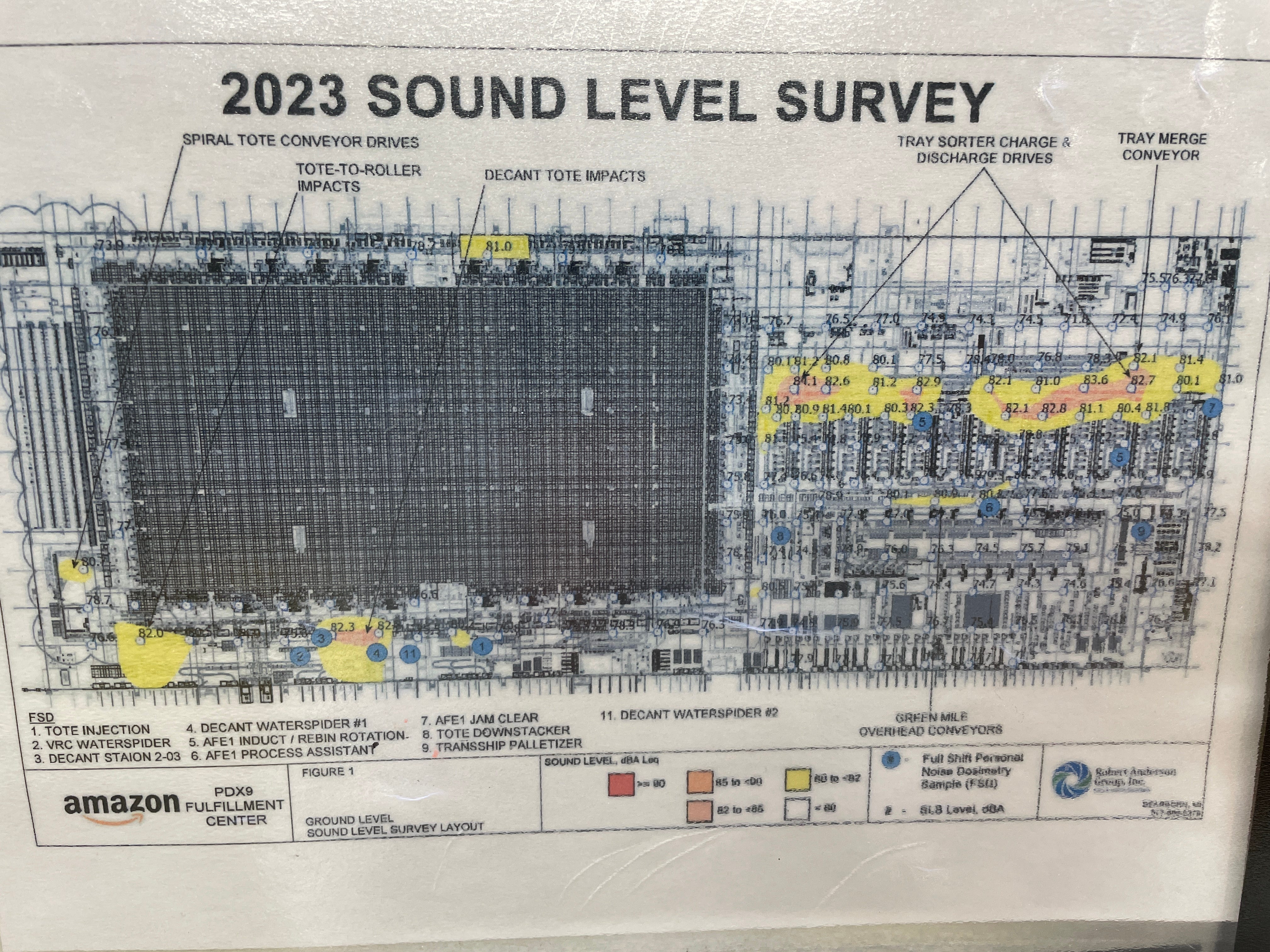
Safety inspection records obtained by The Western Edge show that after those two inspections, no changes were mandated at the facility. But the inspectors did find noise in some areas was regularly between 75 to 84 decibels6 — the equivalent of a constantly running vacuum cleaner or loud city traffic. At that level, the noise inside PDX9 was just shy of the point where OSHA requires immediate mitigation. But the OSHA inspectors noted they had concerns because Amazon employees typically work 10-hour shifts in that constant noise, meaning their exposure was significant even if it fell slightly below hazard standards for an eight-hour shift.
Safety manager Clayton Wayland told the OSHA inspectors he believed noise had increased in the building because of new machines added to the facility in 2022 and because conveyor belts had aging parts. Inspectors noted that Amazon did warn employees about the noise and provided earplugs, protective headphones and hearing tests. Still, Amazon decided to take safety a step further by hanging roughly 40-foot “sound curtains,” stretching from ceiling to floor to tamp down the racket.
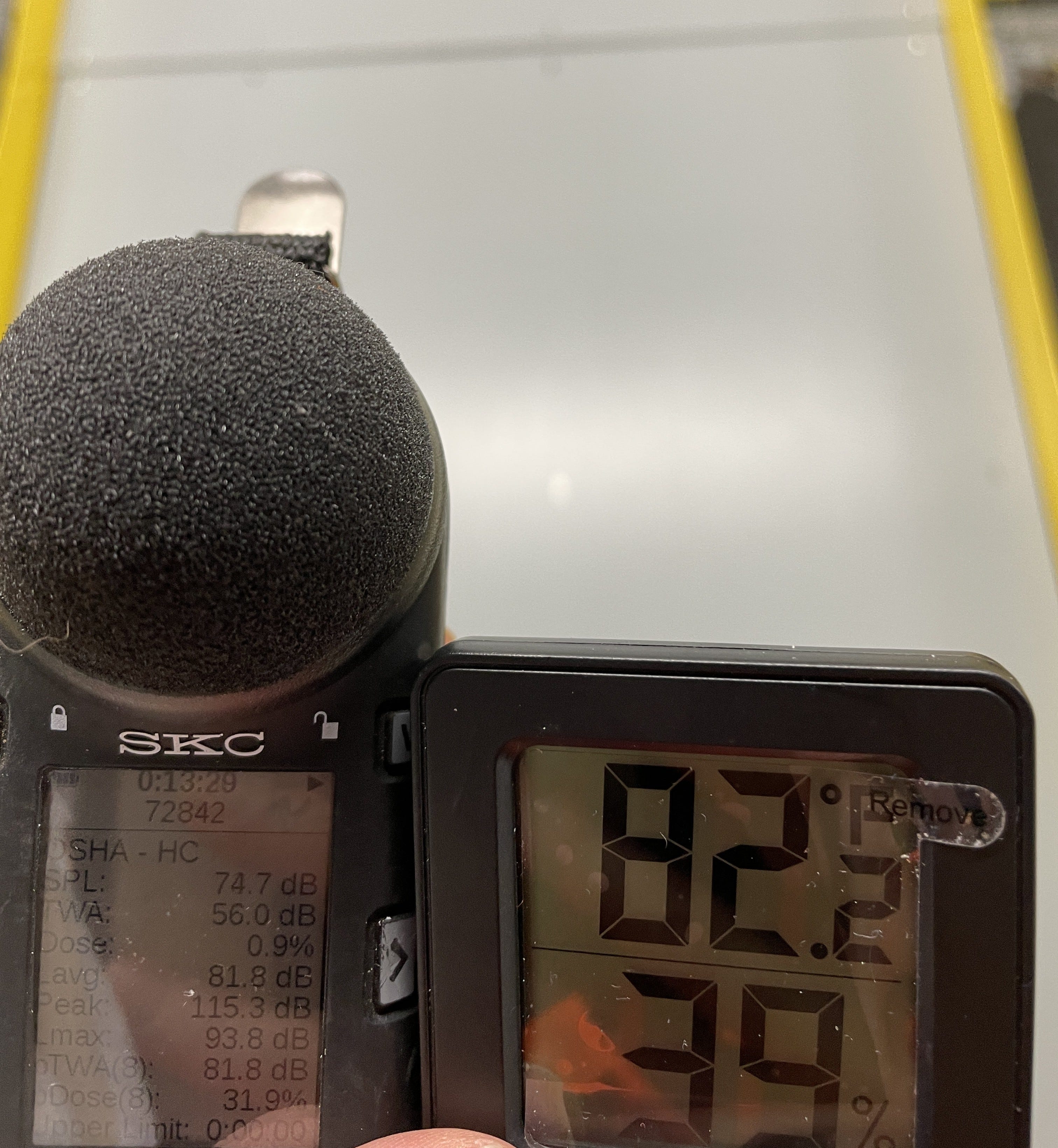
Last summer during their visit, OSHA investigators also noticed that temperatures inside the building was at 82 degrees in some areas with 39% humidity, but said the facility’s air conditioning units were able to cool the building down by the time they finished the inspection.
Employees at PDX9 who spoke to The Western Edge on the condition of anonymity said they believe the sound curtains have made the building even warmer by trapping hot air and restricting air flow.
Amazon has denied that claim; in an April 14 statement the company said “since these curtains were installed in February, the average temperature of the building has decreased.”
Data that measures temperatures for each of the building’s HVAC units, obtained by The Western Edge, tells a different story: The average temperature inside during January and February 2026 was between 72 and 73 degrees. But in March and April, it climbed to 75.
On warm days in the summer months, temperature inside PDX9 can often exceed 80 degrees.
On the unusually warm day Jim Wetmore died, roughly 30% of the HVAC units at PDX9 recorded zone temperatures above 77 degrees. According to sources familiar with internal Amazon systems, the heating and cooling systems are supposed to keep the building between 68 and 77 degrees. On warm days in the summer months, temperature inside PDX9 can often exceed 80 degrees.7
By comparison, the much newer PDX8 facility,8 located in nearby Woodburn, Oregon, did not exceed an average temperature of 75 degrees in July 2025. PDX7, a smaller facility located in Salem, Oregon, had an average below 73 degrees.
In response to questions about the heat data, Amazon said its internal climate data show a decrease in average temperatures “over the last six months,” which would roughly cover November to May. The company did not directly answer why PDX9’s average temperatures were notably higher than similar facilities in Oregon.9
In the aftermath of Wetmore’s death, Oregon OSHA said it has opened a new investigation into PDX9 due to worker complaints. That review remains ongoing, and both OSHA and Amazon declined to comment on the details.
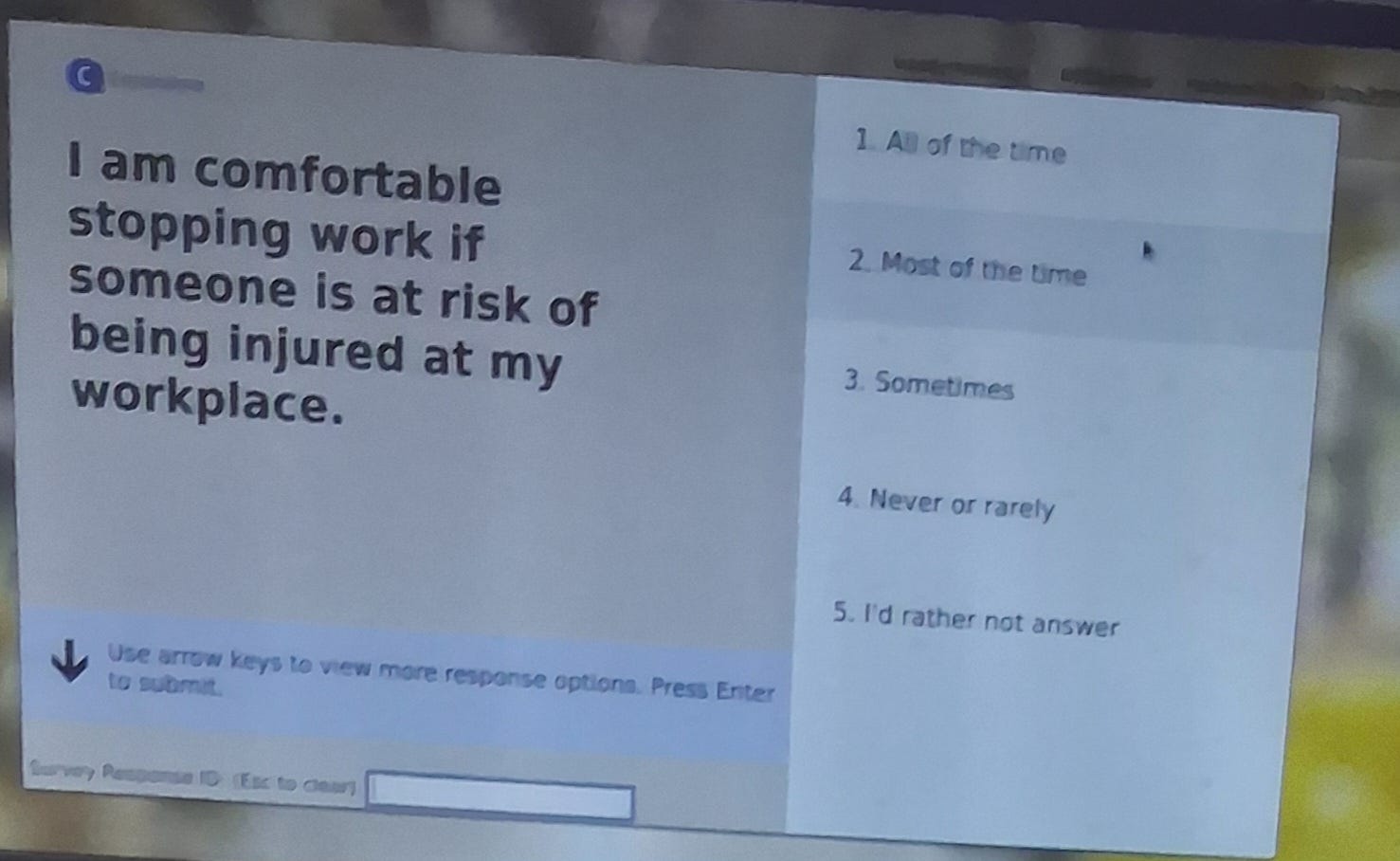
Since at least 2019, investigative reporters, researchers and safety advocates have broadly criticized Amazon specifically, and e-commerce generally, for prioritizing speed over safety inside warehouses. Those critics have reported on injury rates over 40%, on ways Amazon has pitted workers against each other to increase their productivity using a rate system and on allegations that people who complain or try to unionize face retaliation, including job loss.
Amazon has disputed nearly all of these claims, and cites its own tallies of worker injuries, which the company said have declined significantly since 2019.
Depending on the metrics used, injury rates at PDX9 remain high.
Over the past six years, the rate of injuries at the Troutdale facility that resulted in workers missing days or needing to be transferred to other duties has, in fact, fallen from a high of 14.7 in 2019 to 9.9 in 2024, according to the most recent data available from the U.S. Department of Labor. While decreasing this rate by a third is significant, PDX9’s injuries are still more than double the industry average for similar warehouse work.
Amazon spokesperson Sam Stephenson told The Western Edge the company considers employee safety its “highest priority,” and has invested heavily in the area over the past six years. But the company said it does not use days employees are transferred to light job duties as a measure of “safety culture” because those may only reflect minor injuries. Instead, the company focuses on reducing the amount of days employees completely miss work due to serious injury – and on that front Amazon says it stacks up well against its warehousing peers.
Still, PDX9 has recorded at least two deaths and one near-death incident in the past four years, including Wetmore. Another was a man who fell on the job in October 2023 and sustained a head injury. Days later, he died in a hospital. His family said they felt burned by the company after their worker compensation claim was denied.10
The man who lived through his catastrophic injury is Brad Thompson.
Thompson had reached retirement age by the time he went to work at Amazon in 2018, his fully gray goatee standing out against the black outback hat he liked to wear. He started working at the company to stay active and earn some extra money.
Moving packages at Amazon could be difficult, but Thompson liked many of his co-workers and would often fetch them water when they were sweating on the line. He calls his time at PDX9 “bittersweet.”
“At 70 years old, I could work and I felt good about it, but I didn’t like what I saw that was going on,” he said. “There wasn’t anything I could do about it.”
On Dec. 16, 2024, Thompson was coming up on his fourth year of full-time employment at Amazon and needed the money more than ever. He’d finalized his divorce just two months earlier and his bank account was nearly empty.
That evening, Thompson finished his shift as a tote runner.11 He’d worked in that position for more than a year. Despite his age, he’d pushed stacks of yellow totes up and down the lines of packing stations for five hours, walking around nine miles each shift, according to his pedometer.
After his shift, Thompson told a co-worker he’d give him a ride home. Together, they cut across the parking lot toward Thompson’s truck, but as they approached, Thompson felt himself suddenly falling forward, his tired legs trying to speed ahead and regain his balance. His arms flailed.
“Even to this day, I do not remember tripping,” he said. “I was going down like a B-52 bomber in flames, man. I came down hard.”
Surveillance video of the parking lot shows Thompson’s full weight driving his face into the concrete curb ahead of him.
“I came to and I knew there was something seriously wrong because I couldn’t move,” Thompson said over the phone from his home in Washington state, near the Canadian border. “My buddy, Tim, behind me, he asked me, ‘Hey, you all right, Brad? You OK? And I think he shook my foot. And there’s no movement whatsoever.”
Thompson faded out of consciousness again, only to awaken as paramedics were removing his shirt. The vertebrae that connected his skull to his spinal cord was nearly broken in half.
For more than a week, Thompson stayed in the intensive care unit at the Legacy Emanuel Hospital in Portland as health care specialists figured out next steps. He remembers waking up to staff tightening a screw for a neck traction device.
“I tell people,” he said, “I had two good things: They found that loose screw and put my head back on straight.”
He spent more than six weeks in the hospital. Staff helped Thompson learn how to walk again and regain partial use of his right arm, but in the many hours between physical therapy he dwelled on the state of his life: divorced, broke and debilitated as medical bills mounted by the hour.
“There were times I was screaming that I wanted to die,” Thompson said, holding back tears. “I couldn’t even write. I couldn’t do anything.”
While in those depths one day, PDX9 safety manager Clayton Wayland appeared in Thompson’s room at his bedside, according to the former Amazon worker. He asked how Thompson was doing, if he was comfortable. Then, he asked if Thompson knew what caused him to fall.
“I told them the best I could,” Thompson recalled. “I couldn’t remember hardly anything.”
On a second visit, the safety manager brought Thompson a strawberry milkshake and continued to offer sympathy for his condition. (Amazon declined to make Wayland or other managers at PDX9 available for an interview.)
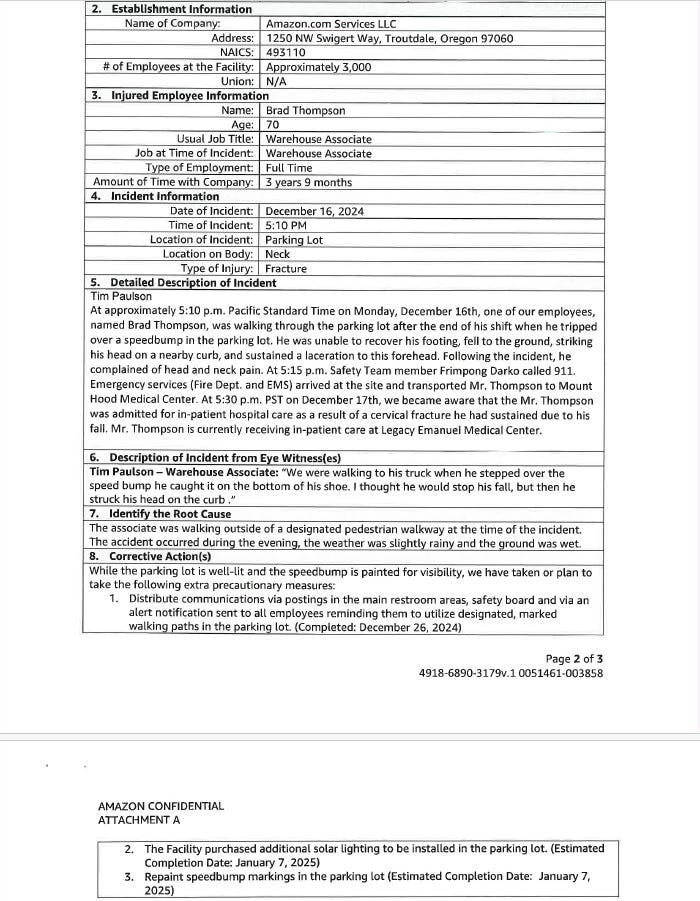
On Jan. 2, 2025, Wayland sent a letter to OSHA explaining the conditions surrounding Thompson’s fall. He said it happened because Thompson had walked “outside of a designated pedestrian walkway” and because the ground was wet. He went on to say that even though the parking lot was “well lit and the speedbump is painted for visibility,” Amazon planned to install more lights and repaint all speedbumps by the end of the week.
It was a surprise to Thompson when Amazon rejected his worker’s compensation claim just a few weeks later in early 2025. Amazon said that decision was made by a contractor that handles claims for the company.12
“They just said it didn’t happen in the course and scope of employment. That was what the denial said,” Thompson’s lawyer, Michael Gilbertson, told The Western Edge.
During a court hearing, attorneys representing Amazon revealed their belief that Thompson fell because of a pre-existing medical condition. Several years into his employment at PDX9, doctors fused some vertebrae in Thompson’s neck to relieve nerve pain he had. The procedure had gone as planned and Thompson continued to work in the warehouse. But as the worker’s compensation case proceeded, Amazon brought in a doctor13 who reviewed his medical records to testify that the previous surgery could have zapped the nerve endings in Thompson’s legs and inhibited his ability to walk.
“They’re begging me to settle this case because I want to stick this case so far up their lawyer’s butt it hurts.” — attorney Michael Gilbertson
Wayland and other managers testified in court that Thompson had an “abnormal gait” before he fell, according to Gilbertson. Amazon’s lawyer asked him to parade around the courtroom, Thompson said. His ex-wife and several of his friends, including the co-worker who was with him the night he fell, testified that Amazon’s accusations weren’t true. Thompson could push totes for nine miles a night, and walk fine until he fell in PDX9’s parking lot.
Gilbertson, a practicing attorney since the 1990s who helped form foundational aspects of Oregon’s worker’s compensation laws, is incensed that Amazon has attempted to avoid paying for Thompson’s injuries.
“They could have played their video at Amazon at any time during the trial to show what they were talking about. They didn’t bring it,” Gilbertson said. “Now, they’re begging me to settle this case because I want to stick this case so far up their lawyer’s butt it hurts.”
Thompson has another hearing in late May and hopes Amazon will back down. His monthly Social Security check barely covers the low-rent room an old friend lets him stay in, and his food stamps aren’t enough to cover his monthly groceries. If he wins his case, Thompson wants to use the money to move into a new place and finally collect his belongings from Portland.
He leans on faith that one day, the company will be forced to pay him what he believes he’s owed.
“When I was in the hospital and I was crying about wanting to die, I literally had asked God; I said, ‘Here I am. I have got no money, no place to live. What do you want me to do?” Thompson said. “And I heard him tell me, ‘Trust me.’ It felt like a big hand just wiping away my tears, and I laid down and had the most peaceful sleep.”
Amazon has often succeeded in pushing back on claims that it disregards worker safety.
Throughout the early 2020s, the agency that oversees jobsites in Washington state dinged the company repeatedly for repetitive motion injuries and fast-paced working conditions. State regulators alleged that workers at three warehouses in the company’s home state faced a “serious hazard” from all the bending, lifting and twisting they needed to do on the job to keep up with Amazon’s work standards.
In October 2024, the Board of Industrial Insurance Appeals found Amazon’s working conditions didn’t imperil their workers and overturned those fines against the company.
When U.S. Sen. Bernie Sanders dropped the final draft of a bulky Senate committee report a few months later, in December 2024, that alleged Amazon’s warehouses are “uniquely dangerous” because the company pushes for productivity over all else, Amazon rebuffed the senator by pointing, in part, to the Washington state court win.
“This report also disregards the results of our aforementioned case in Washington state – even though the senator said the citations in that case were one reason he was opening his investigation in the first place. So, we’ll share the result: after six weeks of testimony from employees, ergonomists, and other experts, a Washington judge ruled in Amazon’s favor,” Amazon wrote in a lengthy reply to Sanders.
The company called anonymous employee complaints “unverified anecdotes” and dismissed allegations in Sanders’ report about excessive heat in its fulfillment centers, noting nearly all of them have a climate control system.
But such rebuttals don’t seem to convince some workers that Amazon puts safety above business.
In an ongoing stream of emails and DMs sent to The Western Edge since Wetmore’s death, a clear message emerged: workers want for Amazon to see and hear them, but many feel, deep down, that may never happen. The sheer size of the company makes that recognition seem impossible.
“This facility has proven in many different ways that health and safety are nothing more than a talking point,” one PDX9 employee wrote on the public My Voice board in the days after Wetmore died. “Unfortunately, this place will continue to get worse as profit and saving on costs will be prioritized over our health and safety.”
Seventy-six of the employee’s co-workers liked the post.14
Pam Wetmore received the glossy, 8x11 cardstock sheet in the “survivor’s guide” packet Amazon sent to her after her son died. The top half was a photo of a sunrise cutting through the clouds above a forested river valley.
“As a living monument to James Wetmore a tree has been planted within the landscapes of the Amazon Rainforest,” it read above an Amazon smile.
Pam pointed to the flyer on the coffee table inside her Troutdale apartment, surrounded by books, jarred candles and dishes that still needed to be packed. Jim had been her longtime caregiver and staying at the apartment was no longer an option.
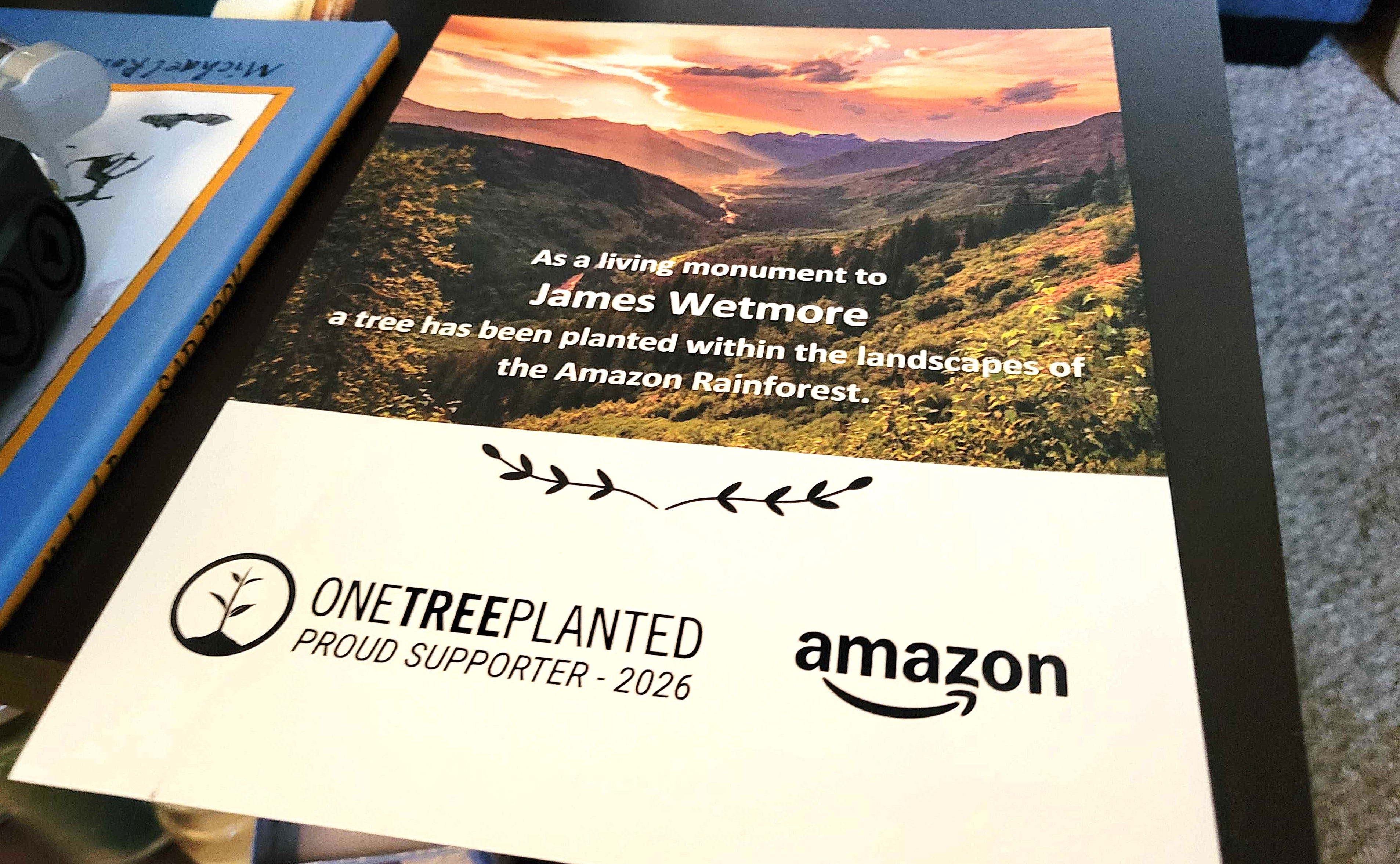
“I said, whoopee ding. Where is this tree at? In the Amazon Forest somewhere,” she said, her son’s cremains resting in a container on a nearby television stand. “That is no comfort to me at all.”
The only comfort the Wetmores have as they plan for Jim’s memorial service later this week are their own memories.
Jim as a child, splashing in the Sandy River and wandering the aisles of the Troutdale convenience store searching for candy. Jim as a middle schooler, shooting past 6 feet tall and giving up his spot on the basketball team because he was worried about hurting the smaller kids.
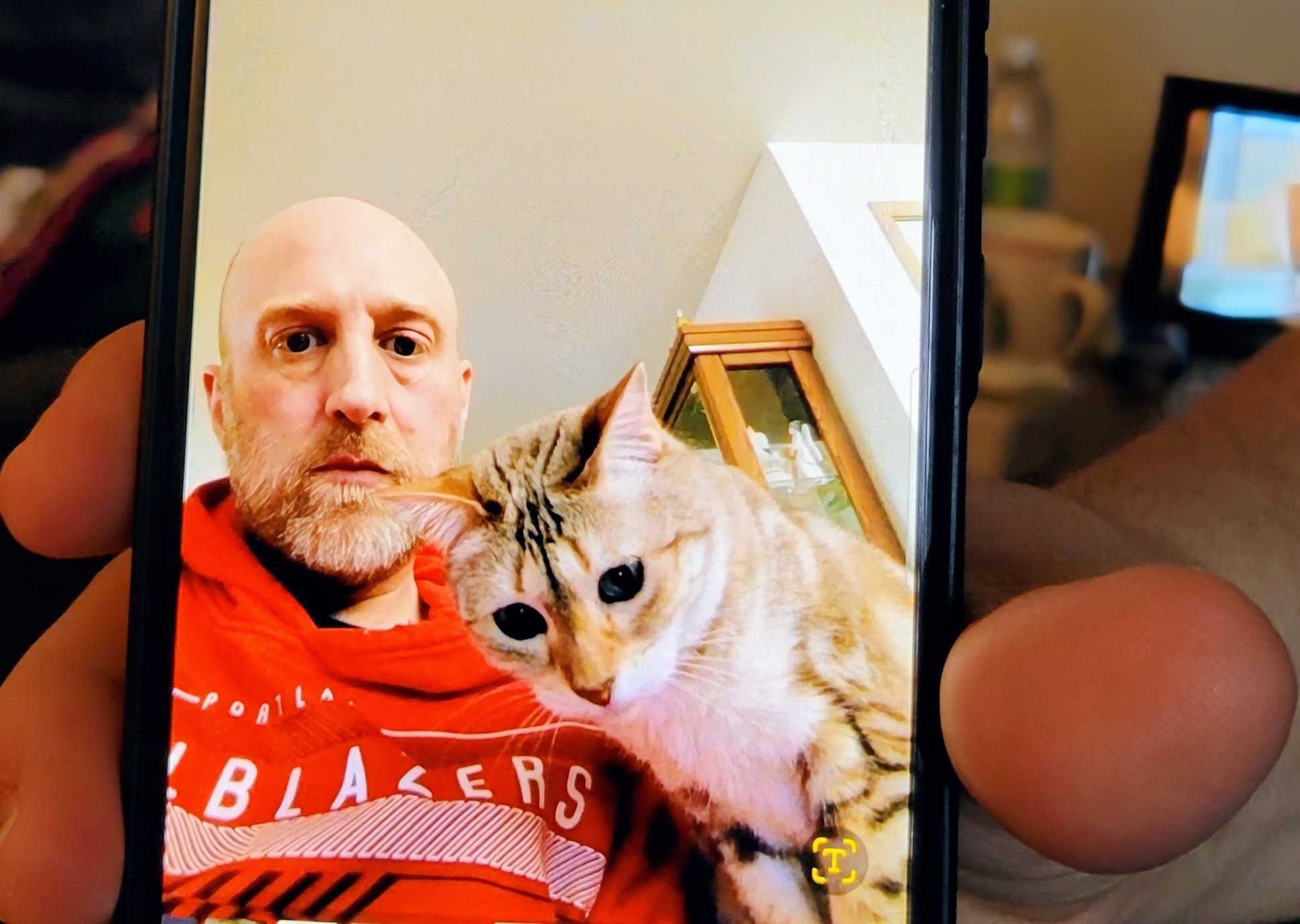
The way Jim would come home from a long shift at Amazon and cook dinner for his mother before the pair would watch their favorite show, The Curse of Oak Island. The way he’d toss a felt mouse in the apartment to play fetch with the Bengal cat he rescued. The way he’d make them laugh uncontrollably.
Their thoughts also linger on who Jim became after he started working at PDX9.
“He was pretty tired most every day when he came home,” Pam said.
“He was always exhausted after work,” Jennifer added.
Jennifer was an Amazon Prime member, but now she wants to cancel her membership. She couldn’t help but notice The New York Times offered a look at the opulent wealth of Amazon founder Jeff Bezos and his wife the same week Jim died, and that juxtaposition grated on her.
In the days and weeks since April 6, employees at PDX9 have called Pam to give their condolences. Inevitably, the conversations turn to the warehouse’s heat, or the speed of the work, or how people are afraid to speak up because they might lose a job they need to survive. They are painful conversations.
Not long before he died, Jim confided in his mother. He told her he wanted to join the safety committee at PDX9. He had grown concerned that managers there didn’t care about the building’s working conditions.
His mother believes her son wanted to find a way, however small, to advocate for his co-workers. He never got to.
Pam Wetmore described the volunteers from Trauma Intervention Program Northwest as one of the few bright spots in the traumatic day. “They were a godsend,” she said. “They sat with me through the whole time.”
Historical weather data recorded high temperatures around 79 degrees on April 6, about 20 degrees warmer than a week prior.
In response to concerns about workers continuing to work after Wetmore collapsed, Amazon issued this statement on April 14: “The area where the incident occurred was cordoned off while our safety teams and EMS cared for our employee, which was their top priority. Nothing is more important than the safety of our employees, and our team focused on ensuring our employee received the care he needed, protecting his privacy, and ensuring the safety of everyone onsite instead of distracting from those efforts by focusing on immediately evacuating other areas of the building in those early moments. Shortly after this event occurred, employees were sent home with pay for the rest of the day.”
Walmart employs more than 2 million people and is considered to be the largest US private employer.
Amazon employees accrue voluntary time off, or VTO, during hours they work. This allows flexibility in shifts for the employees.
Noise was particularly notable in the inbound area, where tote “impacts” spiked the levels as people offloaded merchandise. The noise levels were found to be similarly significant in a 2023 study that Amazon voluntarily conducted. This is the area where Jim Wetmore was working when he died in April.
Amazon facilities in Texas and other southern states sometimes have similar issues staying cool, though outdoor temperatures are often much warmer in those regions.
Both PDX9 and PDX8 are Amazon Robotics Sortable, or ARS, facilities, meaning they use robotics to help with the sorting process. Heat data across the Amazon network indicate ARS facilities can be more difficult to keep cool.
The company did point to a blog post on how it reduces heat at its buildings.
The man’s family tried to initiate a worker’s compensation claim, only to be told they could not because of the way Amazon’s representatives handled an initial death claim. In a statement, Amazon called the man’s death a “tragic situation,” but said it had no insight into the compensation claim because those communications are handled by a “third-party administrator.”
Tote running involves gathering stacks of yellow plastic bins as tall as a person and hauling them up and down the long corridors of the warehouse for delivery to other workers, who will fill them with the goods that go onto trucks. Jim Wetmore was also a tote runner.
Between 2019 and 2024, according to Oregon data, PDX9 had between 280 and 334 workers compensation claims per year. In 2025, that number dropped to 181. Amazon said this downward trend “correlates to our consistent investments in safety at PDX9 and across our network.” The company also said all compensation decisions are decided by its contractor and “independent medical examiners.”
A website for anonymous doctor reviews contains a slew of one-star complaints against the doctor who testified on Amazon’s behalf. “I can only assume her incompetence wouldn’t allow her to practice legitimate medicine to pay off her student loans so she was forced to prostitute herself and any integrity she may have once had by whoring herself out to insurance companies and attorneys,” one reviewer wrote. “I was treated like I was a criminal before a trial,” reads another. “I thought Dr.s took a oath. I didn't know it was to MAKE UP LIE's about patients.”
In response to the message, a PDX9 manager wrote: "We are deeply saddened by what happened. Safety is not just talk, it's our commitment, and we take your concerns seriously. Please connect with any manager on the floor or safety if you have specific concerns you'd like to discuss so we can address them. I really appreciate you for speaking up."
Its just sick how greedy bezos is. How much would it dent his vast fortune to pay a Workers Comp claim? I saw the little SOB on a tv interview recently whining about the bad rap he gets from the press for supporting trump, who he says it turns out has been 'right about a lot of things'. He neglected to cite any examples, strangely. Please reply if you know of any.