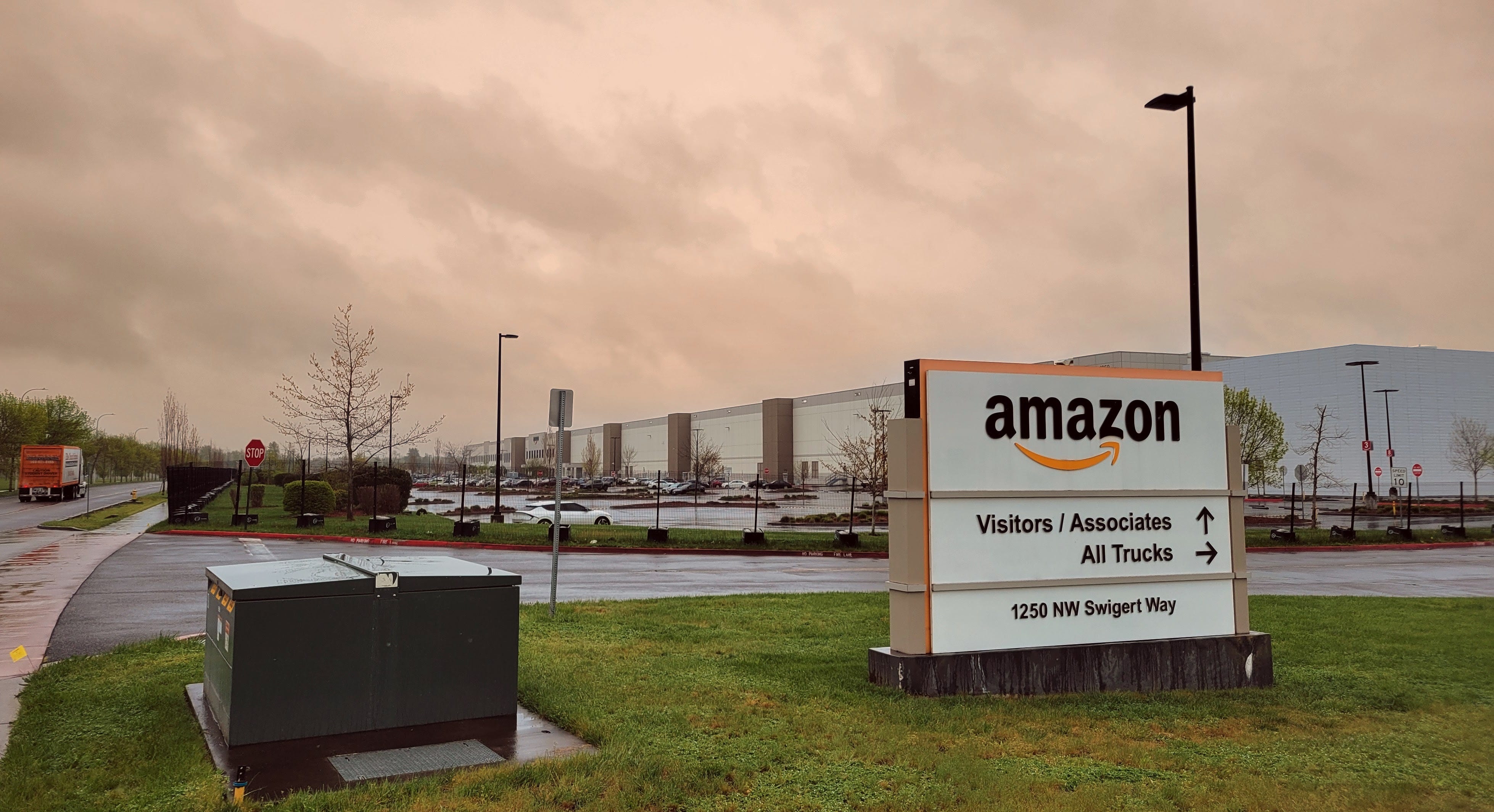
‘Everyone is Replaceable’: Death Rattles Oregon Amazon Facility
A worker died at Amazon’s Troutdale warehouse last week. Employees were told to look away.
Sam was helping unload trucks when a heavy thud against concrete echoed across the Amazon warehouse. An employee’s lifeless body lay on the floor.
Work halted in the loading docks on the south side of Amazon’s distribution center in Troutdale, Oregon. Sam and other employees stared at the person who’d collapsed just 20 feet away. Conveyor belts of packages continued to roll.
“I didn’t have a direct line of sight of the person’s face, but I saw a body form laying lifeless,” Sam told The Western Edge. Employees who spoke for this story requested anonymity to protect their jobs and their names have been changed.
Hours before, a group of trainees on their second day at Amazon sat in a breakroom scrolling Kindles loaded with training materials about what is required of Amazon workers in order to expeditiously shuttle goods to people’s homes across the Portland metro area. They learned how to safely lift packages while meeting the blistering pace the giant retailer expected. There were no training videos for what to do when a coworker dies right in front of you.
The man who collapsed died Monday, April 6 on the Amazon warehouse floor as machinery filled the cavernous loading dock with a dull hum. For more than an hour, several employees said, workers in the facility were instructed to continue fetching totes, picking items off shelves and loading them onto trucks for delivery as the man lay dead, and management figured out their next steps. News of the fatality quickly spread through the building, but workers say top managers did not call operations to an immediate halt. A week later, several workers said they still do not know what caused the man to die.
“Just turn around and not look. Let’s get back to work,” Sam recalled the manager saying.
Within moments of the man hitting the floor, Sam said a woman ran over and began performing chest compressions. The woman began to cry and screamed out for someone to help her.
Sam, who has CPR training, asked her supervisor if she could assist. The supervisor watched the woman heaving her weight into the man’s chest and gave no response.
“I start sobbing and said, ‘I want to help, please!’ I know she’s going to get tired and need to be subbed out,” Sam told The Western Edge.
The supervisor, who Sam perceived to be in shock, had a simple reply: “It has to be management or safety team. Please get back to work.”
“I need to help,” Sam said.
“Just turn around and not look. Let’s get back to work,” Sam recalled the manager saying.
As Sam stood in disbelief watching the woman give chest compressions, the supervisor softly nudged Sam, tears in the manager’s eyes now, too.
“Please,” the supervisor said, encouraging Sam to keep working. Eventually, paramedics showed up and the section of the warehouse where the man lay was closed off.
The death, reported for the first time by The Western Edge, has left employees at the facility in shock and concerned about their own safety. Several workers said they found their bosses’ response too callous; they seemed more concerned with keeping packages moving than with an employee dying in front of them.
“I’ve struggled to sleep,” Sam said. “I have a lot of anxiety over walking back into that building.”
Workplace accidents and injuries are not new at the Amazon warehouse in Troutdale.
A 2019 investigation by Reveal found the Portland area facility had the worst injury rate out of 23 major distribution centers analyzed using data from the Occupational Safety and Health Administration (OSHA). In 2018, more than a quarter of all workers at the building - known as PDX9 - had some type of injury on the job.
Deaths at Amazon facilities have also drawn media attention in recent years in New Jersey, Pennsylvania and Colorado. In 2024, OSHA concluded that a series of three deaths in New Jersey in the span of a month were not Amazon’s fault, prompting a federal lawsuit against the U.S. Department of Labor. When that lawsuit settled in late 2025, it did not find Amazon at fault, and was fully dismissed in February 2026, according to federal court records.
RJ, another worker at the Troutdale facility who spoke to The Western Edge on condition of anonymity, said they often find managers to be unresponsive to employee complaints. RJ described the massive warehouse as a dirty building that regularly sees roaches, gnats and moths unaddressed.
“It makes me feel more ashamed to work there knowing that people can drop dead and we have to carry on”
Public records show OSHA has received at least two complaints in the past five years about heat in the Troutdale building. RJ said the fulfillment center has become warmer inside recently after Amazon installed “sound curtains,” which are designed to dampen the constant noise from machinery. They also prevent airflow, making the building warmer, according to RJ. They said managers had promised to install more fans by the end of May.
“I haven’t noticed a difference in noise level since they started the project,” RJ said. “I think it’s more for the people who work in the offices.”
According to multiple employees, the man who died was working on April 6 as a “tote runner” — a physically-demanding job that involves gathering stacks of yellow plastic bins as tall as a person, loading them onto a cart and hauling them up and down the long corridors of the warehouse for delivery to other workers, who will fill them with the goods that go onto trucks. Sometimes tote runners also act as “water spiders,” an in-house term for a worker who moves filled bins onto conveyor belts that move the goods to other parts of the warehouse for processing.
RJ said the Troutdale facility has recently reduced how many tote runners it employs, which means the few people in those positions work harder and stay in the roles longer than they have in the past.
RJ was not near their coworker when he died, but they were at work on April 6. They continued to work until the end of their 3:45 pm break, when supervisors on shift told all employees to clock out and go home, and that they would be paid for the rest of the shift. The supervisors at that point did not tell all the employees someone had died on the warehouse floor. RJ noticed people lingering in the building until 4 pm, roughly two hours after the man collapsed, according to multiple workers.
“Truthfully, I now have even less respect for our leadership team than I did before, which I didn’t know was possible,” RJ said. “It makes me feel more ashamed to work there knowing that people can drop dead and we have to carry on knowing it doesn’t matter to the higher ups, and everyone is replaceable.”
Amazon did not immediately respond to a detailed list of questions sent to them on Sunday.1
Sam arrived home on the afternoon of April 6 and tried to shake off what they had seen at the warehouse. A few hours later, Sam received a text message from management at Amazon: Employees should report to work as usual the next day. Business would continue.
Sam felt angry, and so did their colleagues. Workers began flooding the “My Voice” section of the Amazon employee app, asking managers to explain why they had kept people in the dark throughout the afternoon.
“I was uncontrollably shaking,” one person said in messages from the app that were provided to The Western Edge. “It wasn’t until second break came that we were finally allowed to stop work and go to the break room. That ain’t right.”
“Amazon was given a 16 billion dollar tax cut to invest in AI and robotics so they can cut 600,000 jobs,” another person wrote. “Do you think Amazon cares about safety?”
“We are just numbers.”
“I find myself floored by the lack of humanity,” another employee wrote, noting they learned about the death from a social media post, not from Amazon.
When Sam returned to work the next day, they saw workers gathered around a screen that displays the employee complaints from the My Voice app for everyone to see.
“It’s so cool in here today,” read one comment on the screen, sent by a worker already on duty. “Did the AC start working before or after we lost an associate? This is an extremely bad look.”
Amazon supervisors responded directly to many of the comments in the app by offering a counseling phone line workers could call, and said people could take unpaid leave if needed. They also offered overtime pay to anyone who continued to work the day following the death, according to Sam. A full week after the death, Sam’s app for tracking their hours showed Amazon had not paid them for the full shift after the workers were sent home early.
Sam said they felt disgusted by the way the man’s death was handled and they are already looking for another job.
“Between being told we should get back to work while a coworker is getting CPR and being told not to help, I just can’t support a corporation like that,” Sam said. “We are just numbers.”
Those questions were as follows:
Do you have any comment on the man who died at the Troutdale facility on Monday, April 6?
Is there an investigation into whether the cause of death was related to conditions at work?
Several employees who spoke to me said supervisors encouraged them to keep working for up to an hour after the man died at the facility. Why was that?
Does the company have any protocols in place when a person dies at work and were they followed in this case?
Are supervisors trained on how to respond to a death at these facilities?
One employee told me they were actively prevented from assisting in care for the deceased person. What is the company response to that?


This is why we need to boycott Amazon, permanently, AND why we need unions.
This is why we need unions.