The Shady Cop Who Haunts Halloweentown
A porn-texting police chief, a mayor posting through it all and the Oregon town that can’t let go of the 2024 election.

In the foggy city of St Helens, Oregon, a tall stone courthouse backs up to the wide Columbia River. It was the backdrop for Halloweentown, a 1998 children’s movie about a girl transported to a town of witches and ghosts. Every October since, St Helens has held the month-long Spirit of Halloweentown festival in honor of the film, where the square in front of the courthouse is filled with pumpkins and cornstalks, and there are haunted houses and psychic readings.1
Until 2023, there was a parade, too. But that ended after charter buses and thousands of people showed up in the small town. Traffic was awful, the sidewalks were crammed, people were pushing each other, and it seemed like Halloweentown had officially gotten too big for St Helens.
A week later, in a small gray-walled room just off the town square, Halloweentown organizers sat in front of the city council and said the parade would be cancelled unless they got more help from local police.
“They’re not supportive in any way,” organizer Heather Epperly said. “All we had was our private volunteers. It was really disturbing. ”
St Helens Chief of Police Brian Greenway stepped up and disputed Epperly’s characterization.
“For people to come up here and slander the St Helens Police department,” he said, growing angry. “Unacceptable.”
Greenway worked events during his 25 years at the Las Vegas Metropolitan Police Department, he said. “I know what I am doing folks. Alright? And when I am telling you this, please heed the warning. We are woefully understaffed to hold these events.”2
In Las Vegas, the family-friendly Halloweentown would have been staffed by 40 officers, Greenway said. St Helens Police employed 21.
“But we’re not Vegas,” Mayor Rick Scholl replied.
Scholl — who has a beard and long hair, and wore his typical University of Oregon Ducks hat and t-shirt — encouraged Greenway to be calm.
“We are a community as a whole — a very small community — and we try to work together,” Scholl explained. “I think there’s stuff we can do better.”
Greenway, his officers and some of their wives had frequently told the mayor and council they needed new cars, a new police station, more money and more officers. Scholl appeared to agree.
“We hear the wives of the officers,” Scholl assured Greenway. “We definitely care about our police department.”
After the meeting, Scholl took Greenway aside and asked him to apologize publicly for losing his temper at the Halloweentown organizers.
It would be months before Greenway apologized. But when he finally did, it would trigger an acrimonious, years-long feud that would spread far past council chambers, and Halloweentown, into the citizenry.
The fallout of that apology would eventually lead to Greenway’s resignation in disgrace, voters booting Scholl from office, bitter political rivalries forming, and the police officers union directly targeting city leaders in its desire for more money.
It would also lead to a contentious 2024 election cycle, when residents chose a new mayor: Jennifer Massey, a union steamfitter, private investigator and wife of a St Helens police officer.
Through an analysis of more than 2,500 pages of newly-released public records and extensive interviews over the past month, The Western Edge has revealed for the first time just how far the small police force in St. Helens was willing to go in its bid for power and money, and how quickly unchecked corruption threw a community into chaos.
St Helens faces a new mayor’s race this year. But the city has not yet found a way to move on from the 2024 election. And with entrenched factions now screaming at each other nearly daily online and in person, it’s unclear if the town will.
In December 2019, St Helens city employees in red and green sweaters piled into council chambers for the annual staff holiday party, where they ate at long buffet tables from paper plates, and held a white elephant gift exchange.
Each year, the same gifts went around — a unicorn head, a silly hat, pink underwear. That year, after everything had been re-gifted, the staffers posed for a photo. City Administrator John Walsh got the unicorn head, and put it atop his own. A woman yanked the underwear up over her black slacks, and everyone stood in front of the council’s dais with their gag gifts as the city recorder took a photo.3 According to multiple sources, Chief Brian Greenway asked the city recorder to send that photo to him.
Four years passed.
On Wednesday, Jan. 3, 2024, Greenway stepped up to the microphone at city hall and read a brief apology, acknowledging he should have listened to the concerns expressed by the Halloweentown committee about the parade and not gotten so heated. Mayor Scholl thanked him.
Less than 24 hours later, an email from a “Concerned Citizen” arrived in the inboxes of Scholl, Walsh, the councilors, county commissioners and several members of the media.
Subject line: “Resignation demand.”
Attachment: the white elephant photo from the 2019 holiday party.
“The pictures are from a city of St Helens Christmas party, attended by City Administrator John Walsh and Mayor Rick Scholl. At this party, both allowed and participated in bullying a young woman into a pair of pink panties and then posed for a picture,” it read. “This is disgusting and I am demanding both John Walsh and Rick Scholl resign immediately.”
“I am beyond disgusted by this. Photos do not lie, and I, along with many others will not stand to have 2 grown men sexually exploit women…. How can we allow the bullying, harassment, hazing and sexual exploitation of women. How many more victims will suffer? Silence is compliance.”
This Concerned Citizen had written to officials before. For years, the account would sporadically surface to lob complaints about Columbia County sheriff’s deputies, or express anger about how St Helens was spending its budget. One email read, “We need more money to hire police officers.” Sometimes the account was signed “Ron Johnson, Scappoose, Oregon.” Others were signed by “A TAX PAYING resident!”4
The Concerned Citizen emailed again a few days later over the “Panty Gate” scandal — as it is known in local parlance — demanding that Scholl and Walsh lose their jobs. Meanwhile, Greenway texted two members of the St Helens Police Association (SHPA), the local officers union, about Scholl and Walsh.
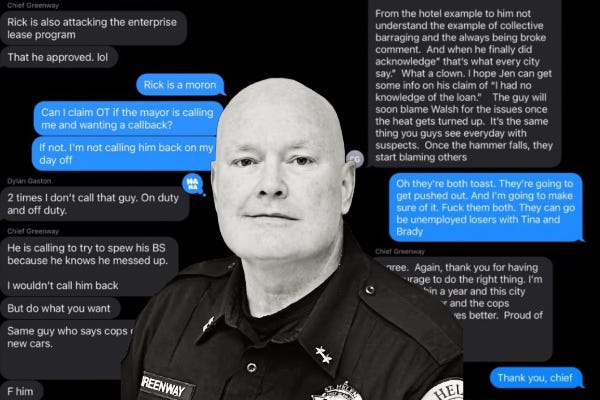
“Rick is a moron,” wrote Bryan Cutright, then-vice president of the officers’ union. “Can I claim OT if the mayor is calling and wanting a callback?”
“2 times I don’t call that guy. On duty or off duty,” wrote Dylan Gaston, the union president.
“F him,” Greenway wrote.
“He’s such an idiot,” Cutright responded. “I can’t believe the system we have lets him have so much power.”
The chief and his officers were angry over police staffing — a point Greenway cited at the council meeting when he blew up over the Halloweentown parade. The city and the department couldn’t seem to find a compromise: Officers wanted to work 10-hour shifts, but that left gaps each day when St. Helens didn’t have enough police for patrol. Greenway asked for more money to hire officers, and for millions to construct a new police station. But by the first week of 2024, some 40% of the city’s general fund was already going to the police department. (Greenway did not respond to a request for comment by The Western Edge.)
By Jan. 10, Greenway’s texts with the two union officers shifted from making jokes about the mayor to Greenway coaching them on what to say at a public meeting that night with Scholl, Walsh and council. “Failure to keep our residents safe through properly staffing and housing the police will result in the city having a new mayor come November,” Greenway texted. “SHPA has lost confidence in the ability of our mayor and city administrator to effectively do their job by placing our residents safety at risk. Just some thoughts.”
This conversation was highly unusual. Greenway was overstepping as the police department’s top leader — someone who union officers would sit across from at a bargaining table, and who would be responsible for disciplining anyone who violated department policy. Walsh was also his boss.
Within hours of that text message, Cutright and Gaston read from statements at the meeting. Greenway listened silently as they lodged a vote of no confidence in both Scholl and Walsh, who they wanted gone. “I implore you all as councilmen and women in this city to force them out of their positions,” Cutright said.
“Oh they’re both toast. They’re going to get pushed out. And I’m going to make sure of it.
Fuck them both.”
— Officer Bryan Cutright
Gaston claimed that by not caving to the union’s demands, the city was effectively defunding the police. “The dictionary definition of ‘defund’ is to prevent a group or organization from continuing to receive funds,” Gaston said, demanding that the city figure out how to pay for more officers and a new police station immediately. “The decision will undoubtedly affect your political careers.”
After the meeting, the three policemen were energized by the public shaming.
“Rick and Walsh need to go,” Greenway texted the next day.
“Oh they’re both toast,” Cutright said. “They’re going to get pushed out. And I’m going to make sure of it. Fuck them both.”
The union was trying to get Scholl’s attention. One St. Helens police officer’s wife was trying to do the same.
“Dude… we need you to get this fixed,” Jennifer Massey texted Scholl at the end of January 2024. “We need you.”
Scholl did not respond.
Massey texted him four more times, asking the mayor to meet in person with her friend, a local political strategist named Jennifer Gilbert.
“We want to talk to you about your campaign this year. We’re hoping that some things can get straightened out and we can help your election,” she said. She and Gilbert did not want a local lawyer, Steve Toschi, to win the upcoming race for the mayor’s office.
“Hey, this is my last effort to try to get ahold of you,” she texted again two days later. “Are you willing to meet and chat? You should also know we have nothing to do with the police association. This is not pertaining to that.”
Scholl never responded.
Weeks later, Massey’s mind had changed. She wouldn’t help Scholl win; she would run against him.
“I am honored to present myself as a candidate for mayor of our beloved city,” she wrote one February morning on Facebook. “My vision for our city is progress, prosperity, trust, and unity through transparency and accountability.”
Massey’s vision echoed a Facebook page she ran called Columbia County Transparency & Accountability, where she posted public records and discussed local issues. She was becoming more well-known in St Helens because of a nonprofit she founded called FAFODDS5 with police union president Dylan Gaston’s wife, Brianna Gaston. The group was part amateur sleuths, part City Hall watchers. Massey’s daughter, Mercedes, and a local man named Adam St Pierre, joined, too.
FAFODDS seemed to be everywhere that spring, having gained a reputation through another Facebook page: Justice for Sarah Zuber, which provided information about the unsolved death of a local 18-year-old girl.6
As Massey revved up her campaign, the FAFODDS crew was vocal about the police budget and allegations of financial fraud by the Halloweentown organizers.
In April, Massey, who works at a Portland mechanical services company, sat before the council and described getting a tour of the police station where her husband worked. “That place is worse than a portable trailer we drag out onto the job sites,” she said.
That month, FAFODDS also handed over a “litany of allegations” against the Halloweentown planners to Greenway, according to a detective at the department who was tasked with looking into them.
But as summer arrived in St Helens, FAFODDS seemed to be growing angry that no one was being held accountable. Massey and St Pierre started showing up at council meetings, hammering a drumbeat that fraud had occurred, and Walsh — having supervised Halloweentown — should be removed from his job.
“I’m just befuddled John Walsh isn’t on administrative leave at this point,” Massey said to the council over Zoom in August. “He’s just bad at his job.”
“Rick,” she said again in early September, “the fact that you have not put this man, John Walsh, on administrative leave at this point and had this looked into…should be a huge concern. I am gravely concerned about what may be found here.”
It seemed that Greenway, Massey and the anonymous Concerned Citizen had the same goals.
By fall, the St Helens mayor’s race was fully underway, and its three candidates sparred publicly and online.
There was Scholl: a landscaper and lifelong Columbia County resident who had been mayor since 2017 and put less than $1,000 into his re-election bid.7
He was up against big spenders.
Steve Toschi — a lawyer with an expertise in fraud cases who had recently moved to St Helens8 — poured tens of thousands into his bid for mayor. Toschi wanted to bring wealth into the community, and spoke on the campaign trail of finding ways to keep unhoused people from sleeping on city streets.
Massey spent tens of thousands on her campaign, too. On her signs and mailers, her face was next to the St. Helens Police Association logo.

Since at least 2021, St. Helens officials had deliberated over what to do about police staffing and talked about a day when 24-hour police service could go away.
For unclear reasons, mere weeks before voters cast ballots in the pivotal mayor’s race, around-the-clock police service abruptly stopped.
Greenway stood outside the police station and explained to a television reporter from Portland that St Helens police could no longer patrol at all hours, leaving a four-hour gap unstaffed.
“The chief wouldn’t say what hours officers won’t be out patrolling for obvious reasons,” the reporter said at the end of the segment.
But those hours wouldn’t stay secret long. That night, Jennifer Gilbert — Massey’s friend — slammed Scholl and Walsh at a city council meeting for causing the cuts and jeopardizing public safety by not spending more on police.
“I know of one officer who worked their shift, went home at 3 a.m. to bed, 45 minutes later was called back out,” Gilbert said, making it clear the specific times when St Helens was without police.

Afterward, Greenway was irate. Gilbert later said that she only knew those specific policeless hours because Massey had told her just before the council meeting: It was her husband, Terry, who had been called out overnight.
Confusion over policing deepened in the city when Walsh, the city administrator, put Greenway on leave within a week of that meeting. Out of public view, Walsh fired off emails to top leaders saying he’d recently learned Greenway had allegedly engaged in “unethical behaviors.” He was in talks with a third-party investigator to look into Greenway.9
That investigator, a former Oregon police chief named Jim Band, said he’d not only look into Greenway’s fixation with police staffing and claims he’d obstructed recruitment efforts, but that he had bullied people inside and outside the department, and egged on the officers’ union to undermine city leaders.
Before the public knew why Greenway was put on leave, Massey hopped into her car and drove 34 miles from St Helens to his home in Vancouver, Washington.
She told The Western Edge that she made the trip, instead of calling him, to demand answers about what was happening. She explained that, as a licensed private investigator, she and FAFODDS “wanted the exact reason he was put on leave.”
They were concerned St. Helens may have retaliated against him.
Greenway knew his time as police chief was ending. His lawyer wrote to the city just weeks before the 2024 election, offering a golden parachute deal for the chief’s silent departure.
“If the City wants to skip the Greenway investigation, which would yield little if anything, Chief Greenway would agree to the following terms,” the email stated before asking for a year’s salary, a job reference and tens of thousands of dollars in compensation for allegedly unused paid leave.
As Massey was winning over the public in the mayoral election by lambasting Scholl’s handling of the police, behind the scenes people were coming forward with damning evidence against Greenway.
Dustin King, a former corporal at the department, said Greenway created a dangerous policy banning St. Helens officers from helping neighboring departments. King described an officer who had recently traveled outside city limits to stop an active shooter.
“He was very upset when this policy came out and the chief told all of us in a staff meeting when he pushed this policy, ‘If you don’t like it, you can work somewhere else,’” King said.
Other officers told Band how Greenway referred to the local sheriff as “muffin tits,” how he’d log into public Zoom meetings in neighboring cities under names like “Mike Oxlong” or send pornographic memes to officers as a gag.
Then there was Cutright, the union vice president who worked with Greenway and Gaston to push the no confidence vote against Scholl and Walsh. Cutright said Greenway let him skip a physical fitness test required of all officers, and gave him a raise as if he had passed anyway.10
“He said that he was going to write down my time and I was not going to run it,” Cutright said. “I kind of looked at him a little weird, and he said, ‘Is that a problem?’ And I said, ‘Guess not.’”
One young detective described how Greenway screamed at him. The department’s second-in-command said Greenway sabotaged hiring more officers so the city would feel pain and give the police department more money. Other officers told Band how Greenway referred to the local sheriff as “muffin tits,” how he’d log into public Zoom meetings in neighboring cities under names like “Mike Oxlong” or send pornographic memes to officers as a gag.
Det. Matt Smith said Greenway summoned him to his office on April 15, 2024, just two months after Jennifer Massey had launched her mayoral campaign, and handed him a letter from FAFODDS outlining their beliefs in alleged Halloweentown fraud.
Greenway told Smith that Walsh needed to be placed on leave because he had overseen the alleged fraud — echoing FAFODDS’ talking points. Smith quickly turned the investigation over to the FBI and IRS; later, he described being caught between his boss, Greenway, and Massey, a citizen and political candidate.
“This has caused me to try and placate everyone involved,” he wrote to his supervisor.11 “Constantly assure Mrs. Massey that the feds will handle the case, to be patient and not post anything on social media,12 while also resisting all efforts by Chief Greenway for updates and Mrs. Massey to write follow up reports and continue the investigation.”
Massey and Greenway seemed to want the same things: get rid of Scholl and Walsh, and secure more money for police in St. Helens.
Looking back, Scholl believes he came under fire because he wouldn’t capitulate to police union demands.
“(The union was) just being crybabies. That’s what it is,” Scholl told The Western Edge. “They were shaking us down for more money.”
In the heat of the election, residents on Facebook agreed with Massey that Scholl wasn’t supportive of police. Scholl, who will refer to Facebook as “Fakebook” at any opportunity, refused to duke it out online.
On Election Day, after a vicious three-way race, voters ousted Scholl.
Massey won.13
Band also concluded that the city had not defunded the police at all, noting that the budget had doubled under Scholl’s time as mayor from around $2.8 million in 2018 to $5.6 million in 2024 — a budget that was was comparable, or better, than other similarly-sized Oregon cities.
The final report about Greenway by the investigator, Jim Band, landed on her desk mere weeks after she was sworn in.
“Chief Greenway seems to have worked up the union and members of the public with misguided information,” Band wrote. “Greenway seemed more preoccupied with some sort of personal vendettas against former Mayor Rick Scholl and City Administrator John Walsh than with the community expectation of his job as chief.”
Band also concluded that the city had not defunded the police at all, noting that the budget had doubled under Scholl’s time as mayor from around $2.8 million in 2018 to $5.6 million in 2024 — a budget that was was comparable, or better, than other similarly-sized Oregon cities.
Greenway was on leave, but with Massey’s win, he’d gotten what he’d wanted: a new mayor who believed the police needed more.
But the drama was not over.
At the request of a city attorney who was growing increasingly suspicious that Massey had worked with Greenway during the 2024 election to stir up fears around a policeless town, Band produced a supplemental report.14
He spoke to Jennifer Gilbert, Massey’s friend and political strategist. The pair had a falling out, and Gilbert offered Band information about what she knew.
In the end, Band drew no conclusions about Massey’s relationship with Greenway; he did not interview Massey because the former chief resigned abruptly, effectively ending the investigation.15
In an interview, Massey answered questions by The Western Edge about the nature of her relationship with Greenway. She went out to eat with the chief two years before the election, spoke with him on the phone about issues around department canines and had only seen him in passing at police events.
“I didn’t have a bad opinion of him,” she said. “He seemed very factual, technical.”
She denied allegations that she colluded with Greenway on halting 24-hour police service in the final stretch of the mayor’s race. A spokesperson from St. Helens told The Western Edge the department “currently staffs two 10-hour shifts per day and covers the remaining four hours through a combination of on call officers and/or overtime.”16
Still, some people in St. Helens don’t buy Massey’s story.
Gilbert is one of the leading voices in a growing chorus of residents who see Massey continuing Greenway’s no-holds-barred approach to local politics.
“There was rumors that she and the Chief had been colluding, and then a bunch of stuff clicked in my head,” Gilbert said to Band during the investigation. “And I was like, ‘Do you have any explanation for what’s going on?’ And she was like, ‘I didn’t do anything.’ And she got kind of defensive, but she’s like, ‘I don’t even know what happened.’”
Last year, in February 2025, after the St. Helens City Council voted to publicly release a redacted version of Band’s investigation, Gilbert checked her post office box. Inside, there was a letter from a “Concerned Citizen,” mailed from Portland.
It contained just one line:
“OOPS,” it read. “YOU HAVE BEEN FOUND OUT.”

Steve Toschi lives in a restored craftsman overlooking the Columbia River with a view of boats docked in long lines and fog moving across the landscape.
One afternoon this February, he wore jeans held up by suspenders and a red plaid shirt. He sat at his kitchen table, a wild enthusiasm in his eyes as he spoke about Mayor Massey and her connections to the city’s police union.
“The integrity of the police department is being compromised,” he said. “Pretty soon people are going to say the word of a St. Helens police officer isn’t good. ‘You guys are crooked.’”
Toschi came in third place in the November 2024 election, and afterward figured he’d step back from city politics.
But when Band’s redacted report became public, he flipped through the 108 pages and felt himself growing angrier.
Toschi filed a lawsuit against St Helens, seeking all of Band’s investigative files and an unredacted version of the full report — revealing his sources. Last month, he won.
“We’ve got our pig pig pigs — I mean, our greedy police. Do we reward them or do we say, ‘You guys need to manage yourselves?’”
— Steve Toschi
The release of public records in any other city might not be cause for news, but when the city dropped thousands of pages of Band’s files into the public sphere, local Facebook pages exploded with commentary.
“BREAKING NEWS BREAKING NEWS BREAKING NEWS!!!!” read one local poster.
The comments made one thing clear: no one in St Helens saw the records the same.
“A victory for the people for sure!” wrote one local woman on a post by Toschi.
“Toschi is an idiot, it’s total bullish!t that he continues to try and push this narrative!” wrote another resident on a post by Massey.
Toschi was at home reading the texts between Greenway, Cutright and Gaston. “I think the cops weren’t saying we want a new station. The cops are saying, ‘we want a raise, we want more money. We want more stuff. We want better gear. We want dogs, we want new cars, we want body cameras,’” he told The Western Edge. “I see the police union saying ‘we want power. We want influence.’”
Toschi characterizes the 24-hour police crisis of 2024 as an unauthorized “strike” by local police refusing to work.
“Our people were actually put in danger by this behavior,” he said. “Massey shamed us. Greenway shamed us. Our police association shamed us.”
He believes the records show the police union capitalizing on public safety fears as a way to install Massey, who would finally open the city’s checkbook to the officers.
“We’ve got our pig pig pigs — I mean, our greedy police,” Toschi said. “Do we reward them or do we say, ‘You guys need to manage yourselves?’”
In her first year as mayor, Toschi made a complaint to the Oregon Department of Justice alleging that Massey and Greenway created a crisis out of the 24-hour policing issue to win the election.
In November 2025, the DOJ declined to investigate further, saying it was “unlikely an investigation will produce evidence of corrupt or coercive activity on the part of Massey to support a prosecution.”
Toschi has no kind words for the DOJ, but admits what many people in St Helens will not: In more than 2,500 pages of records, there is no smoking gun proving Greenway and Massey colluded. Still, he doesn’t believe Massey is innocent.
“I don’t think I have to put the four after 2 + 2,” he said. “At some point, we as human beings need to realize that people who are trying to get away with shit deny that they did it. And it’s up to us to come to the appropriate conclusion.
“You know why I have it out for Jennifer? People who live in the ethical world like me, I judge her. I think she is scum. She’s dangerous. She’s a liar. She’s a cheat. She isn’t who she says she is. She’s a fraud. Those are words that I use for people like her.”
Later this year, the St Helens mayor’s election will happen again. Toschi said he is considering another run for office, but hasn’t decided yet.
For now, he is content being one of several loud voices who show up to city council meetings to talk across the room at Massey, who sits at the center of the dais. It’s a fight he won’t let go.
“Here at ground zero in our little tiny town, we have a serious corruption issue. So don’t complain to me about Trump or Biden or the Democrats or the Republicans, when you’re not willing to pay attention to this place,” he said. “Don’t you want this place to be better? Don’t you want St. Helens to be the gem of the river that it could be?”
On the day the documents became public, Jennifer Massey felt overjoyed.
“This is like Christmas for me,” she told The Western Edge. “I have been waiting for over a year.”
She invoked a value she’s championed since before her mayoral campaign: transparency. “Toschi shouldn’t have had to go to the extent he did for public records,” she said.
“I guess it was a relief for me personally because there’s that veil of mystique and all of that stuff that people can create narratives,” she said. “And when you just put the documents out there, they’re out there.”
She explained that she started to have a problem with Scholl and Walsh when she felt like they ignored her citizen sleuth organization, FAFODDS, and its allegations around the Halloweentown finances.
“We would send emails to [Scholl] and he would just ignore us, and would not respond, wouldn’t even open the emails,” she said. “We felt as citizens, if there were concerns and you’re sending information, that you owe, as an elected official, you should at least open them … we were just ignored for over two years.”
In a small city, people have a closeness with city leaders. They expect them to work for them. And Massey felt entitled to their attention.
“What we were doing is basically being the voice of many citizens,” she said.
The documents show one leader was listening to FAFODDS: Greenway. When she handed over their Halloweentown investigation, he told a detective it was a top priority. If Massey had questions, she said, he would talk to her on the phone.
But Scholl didn’t make time for her.
“These are the things that drove me eventually to wanting to run for office as my frustration kept building. It’s like, okay, so now you do all this work, and you’re trying to present information for key stakeholders that actually can make decisions, and it’s falling on deaf ears?” she said.
Even though Massey said she supports Band’s investigative files becoming public, she downplays their significance. She pointed at how some of the most damning allegations about Greenway came from the department’s one disgraced officer, Bryan Cutright.
“Cutright was terminated for alleged misconduct, being untruthful,” she said, “then all of a sudden he’s truthful enough to be in the Band report? Like, that seems kind of weird to me.”
And Band never interviewed Massey to get her perspective.
Massey told The Western Edge that she doesn’t think she should recuse herself in decisions around policing, despite her alignment with Greenway’s goals in 2024, her connection to the union president and his wife, and her husband working for the department.
“I don’t feel like I need to recuse myself because I don’t feel that there’s anything that I have done that is improper, unethical or incorrect,” she said. “Why would I let this small group of individuals that I feel has created a narrative on their own personal reasons — why would then, all of a sudden, I should just recuse myself? That doesn’t make sense to me.”
In the days after the files became public, Massey seemed to be parked in the comments sections of local Facebook pages, responding to citizens with screenshots from the documents. Her biggest detractors shared AI images of Massey dressed like a mobster. One day, she shared AI images of herself: seated at a desk covered with piles of papers and a newspaper reading “POLITICAL HIT PIECE.”

She also took a victory lap on her YouTube podcast, “The Find Out Phase,” which she hosts with her FAFODDS colleagues: her daughter, Brianna Gaston and St Pierre. They sat in front of a gun safe and a background bearing the group’s logo: a figure holding the scales of justice.
“We’re providing the receipts,” Massey said as she read portions of the records aloud, “which I think makes our organization different than just people out there spouting a bunch of bullshit.”
For an hour and 15 minutes, the group read records, talked about Facebook comments and made jokes, pouring even more fuel on the fire of an already divisive situation. Massey laughed with her co-hosts and, at times, appeared not to understand why some St. Helens residents did not share her view of the records.
Brianna Gaston — wife of the police union president — sat quietly through most of the podcast, but then chimed in.
“Shit, I just think it’s because we just dropped this bomb on tourism,” she said, referring to the FAFODDS allegations around the Halloweentown organizers. “So now it’s the police and the wives versus tourism, and we blew the lid off that.”
“It’s main character syndrome,” said St Pierre, referring to their critics while inexplicably dressed in a Where’s Waldo costume. “They all just want to be really involved.”
The next week at city council, in a special session, Massey sat on the dais scrolling through a list of slides about the city budget. One showed a pie chart indicating the percentage of the city general fund given to each department. The police get half of the St Helens pie.17
Afterward, citizens lined up for public comment. Most talked to Massey directly. One was Brady Preheim, the host of a local political radio show.
For three minutes he read from the documents, including the text exchange between Greenway, Cutright and Gaston — the one remaining person in that group chat still employed by the city.
“Tell me how it is that you sit here and you think that’s okay. That someone that has been sworn, they’re telling you they’re going to get rid of the mayor,” Preheim said. “Explain to me how it is this officer continues to be employed by the city of St Helens.”
Massey spoke up: “Mr. Preheim, your time is up, please” she said.
“I think your time is up,” Preheim shot back.
Preheim and Massey, who are next door neighbors in St. Helens, then shouted at each other, both trying to get the last word. Their voices bounced off the walls of the small room.
In the last few years, a walking tour of locations from Twilight has become a part of Halloweentown. While the famed movie franchise was predominantly shot in Forks, Washington, St Helens was the site of several locations from the films, including Bella Swan’s house, an alley, and a parking lot where Edward saves Bella.
Brian Greenway, in public meetings and in a St Helens press release announcing his hiring, said he served as “incident commander” during the 2017 mass shooting at the Mandalay Bay Resort, in Las Vegas, which left 61 dead. The Western Edge reached out to Las Vegas Metropolitan Police Department to confirm this, and received hundreds of pages of reports detailing the department’s investigations of the shooting. Greenway’s name was not listed once. Records did show, however, that Greenway was on the scene of the 1996 fatal shooting of rapper Tupac Shakur.
The city recorder has said in emails to citizens that the panties were taken out of the white elephant gift rotation in 2020.
The wife of a Ronald Johnson in Columbia County, when reached for comment, said she and her husband had no knowledge of the email address or the 2019 Christmas party, and expressed concerns about her husband’s identity being used without his knowledge or permission.
Massey will variously define the acronym as standing for Friends Against Fraudulent Organizations Doing Detective Stuff or Fuck Around Find Out Doing Detective Shit.
In 2022, Massey’s husband, Terry, made a failed run for Columbia County Sheriff, promising the Zuber family new eyes on the unsolved case if he won. When he did not, Jennifer Massey offered to help the family. In 2025, Western Edge reporters Leah Sottile and Ryan Haas released the eight-part investigative podcast Hush about the case. It found that FAFODDS pushed a theory Zuber was killed in a hit-and-run, despite two medical examiners saying her injuries did not reflect being hit by a car.
Scholl made headlines in 2018 when he rescued a local family whose boat broke down in the Columbia River, and the sheriff’s office said they couldn’t respond.
Toschi’s wife, Robin, grew up in St. Helens.
Several sources confirmed to The Western Edge that Walsh, Scholl and a city attorney held an October meeting at a city park in nearby Scapoose, Oregon. There, St. Helens Police Lt. Joe Hogue outlined for the first time a litany of concerns he had about Greenway’s actions.
Cutright would later deny to Jim Band, the investigator, that Greenway initiated the no confidence vote in Scholl. Gaston said he could not remember whose idea it was. St. Helens police fired Cutright in 2025 because it found he had lied about entering someone’s home without a warrant. The Columbia County District Attorney’s office has just one name on its Brady List of unreliable officers: Bryan Cutright.
Smith would eventually become police chief in St. Helens after Massey became mayor. His appointment remains a point of active litigation; former Acting Police Chief Joe Hogue is suing the city and Massey for alleged retaliation after he blew the whistle on Greenway.
The bolding is Smith’s.
The mayor of St Helens is a two-year position.
That attorney, Akin Blitz, worked for roughly three decades as a labor lawyer for St. Helens. In his memo, Blitz said “the city has been placed in a position of jeopardy by Mayor Massey’s actions.” Since the memo became public last month, Massey told the Columbia County Spotlight that Blitz drafted the missive to discredit her because she “did not appoint his friend of 25 years,” Joe Hogue as police chief. Speaking to The Western Edge, Hogue denied any close relationship with Blitz. “We were not personal friends. Our interactions were professional and mostly limited to the short time I was the Acting Chief,” he said in a statement.
Greenway also stopped negotiating for a payout from St Helens and retired with no compensation package.
St. Helens has provided a fleet of 13 vehicles officers can take home for on-call hours. “Once a new police facility is constructed, it is anticipated that the fleet will be reduced significantly for cost saving purposes and because it is anticipated that the police department should be fully staffed by then to provide 24-hour shift coverage,” city spokesperson Crystal King said in a statement.
The city of St. Helens told employees March 3 it will need to furlough 26 employees one day per week starting in May 2026 due to budget shortages. Those furloughs do not affect unionized police officers.


Older history of this region:
https://www.oregonencyclopedia.org/articles/anti_nuclear_movement/
The Trojan Nuclear Power Plant was located in Columbia County, Oregon, approximately 12 miles north of the city of St. Helens. The plant was situated on the Oregon side of the Columbia River, while the mountain itself is roughly 30 miles away from the site. The facility was demolished in the early 2000s